Showing posts with label America. Show all posts

Wednesday, January 31, 2018

March by Geraldine Brooks

While Little Women has become so many people's favorites, I have failed to recognize its high value when I read it few years ago. It was difficult for me to relate with the story, that it just flowed to the end without deeper influence. It felt like an old blanket; comfortable, but nothing else.

Only after I read March, did I realize the reason. March was inspired by Little Women; telling the historical events of the 19th century American Civil War from the point of view of the missing father of Meg, Jo, Amy, and Beth. However, to me, March felt more realistic than Little Women because Brooks made March and Marmee true persons with their weaknesses and struggles; while in Little Women they were like Mr & Mrs. Santa Claus—too good to be true!

March was actually inspired by Amos Bronson Alcott—Louisa May Alcott’s father—who was a teacher and abolitionist. But instead of teacher, Brooks made March a chaplain. As we already read in Little Women, March left Concord, Massachusetts to serve in the Civil War as soldier’s chaplain. In his letters to home, he told everything but the real horror and brutality in the battlefield, for he didn’t want to add burden on Marmee and the children. Then he caught a severe illness and was brought to hospital, where Marmee immediately went to nurse her husband. Then and there she learned for the first time the damage war had wrought into her husband.

I don’t think Brooks wrote March (and won Pulitzer Prize in 2006) only as a fanfiction or to reminisce over one of the best-loved classics. She focused on the warfare; how it has touched every family and changed the veterans’ personal lives. To do that, picking March as the central figure is ideal, since his absence in Little Women gave Brooks rooms to explore the influence of war to men, and kind of recreating the story—if not one of the characters—of the best-loved classic. Moreover, Alcott’s history as an abolitionist might have given Brooks more rooms to write about racism and slavery.

I loved how March discusses about cowardice. I remember one episode of Downton Abbey (TV series) where Mrs. Patmore was troubled when her nephew’s name was excluded from war memorial given to the village because he was shot for cowardice in WW I. I remember being shuddered while watching that scene, as I thought how easy it was for us—who have never been in the war, or perhaps been in the war but not in that specific moment—to label others with “coward”. While survival is human instinct, is it really disgraceful when one selfishly saves oneself instead of risking life for saving others? I mean, morally it is not right, it is not ideal. Still, not everyone is blessed with bravery. And having just several seconds to make decision at a critical moment, sometimes there are a lot of things one must consider (one’s family, for instance). It is really not easy to be brave to accept death. And I think it’s enough that one must account his actions to God, without having to face society’s sanction for the rest of his (and his family) life too. So I won’t blame March for doing (or not doing, in this case) what he supposed to do in the battlefield. And I can relate with his guilt afterwards; how he must bear the burden alone; how it changed his life forever. I was glad that Marmee and Grace Clement never blamed him. And it was kind of Marmee too to try to understand his relationship with Grace.

War… there are things that only those who participated in it can relate to. I am glad I have finally been able to read this magnificent book. Pulitzer Prize or not, it is the kind of book that opens your mind and change your perspective.

5 of 5


Tuesday, January 6, 2015

The Paris Wife

It’s said that “Behind every great man there’s a great woman”—in Ernest Hemingway’s case, Hadley Richardson was that great woman. Hadley was Hemingway’s first wife; he loved her very much, but somehow his troubled and unstable soul—and perhaps the corrupted age they lived in—torn out their happy marriage. The Paris Wife is a fictional story of their lives, written from Hadley’s side, but Paula McLain told it closely following the historical facts, which made this book very interesting.

Hadley Richardson was twenty eight on October 1920, a plain young woman with a plain and boring life who was still mourning over her mother’s death, when she first met a ‘beautiful boy with brown eyes’ whom introduced himself as Ernest Hemingway. Hemingway was then a war veteran, and was starting a literary career by writing for magazines. It’s obvious from the beginning that he had ambition to be a reputable writer. Shortly they fell in love, got married, and lived in a small apartment in Paris.

Living in Paris during the Jazz Age meant paradise for young talented writers or artists, but it’s not suitable for a conservative young woman like Hadley. But Hadley loved Ernest so much, that she dedicated herself to bring her husband’s career to the top. Accompanying Ernest, Hadley tried to mingle with the rising writers at that time, Gertrude Stein, Ezra Pound, F. Scott and Zelda Fitzgerald, etc. Ernest got the safety and stability feeling alongside Hadley, that he could pound his way to what his talent could produce; while Hadley got the man she loved very much—maybe too much. Everything should have got on very well, but then complicated things happened. First a baby appeared, then a woman (Hadley’s best friend) entered their marriage life.

Maybe Kate (Hadley’s friend before she married Ernest) was right from the beginning. Hadley shouldn’t have married Ernest, for “he liked women very much”. But then, marriage was what has saved Hadley’s life at that time, and she loved Ernest so much. To marry a talented and ambitious writer means a sacrifice. For Hadley, it’s okay. She could endure hours and days of loneliness when Ernest retreated into his passionate writings. She could endure Ernest’s changing mood and unstable emotion, including his war trauma. She could also endure the awkwardness being a conservative among the moral lose people of the Lost Generation. She could endure all those, as long as she still had Ernest’s love. So when Pauline Pfeiffer stepped up and seduced Ernest to leave his former wife, everything collapsed. I was so relieved that finally Hadley found a loving husband who led her to a happy normal life.

World War I has created what we now call the Lost Generation, the disoriented and confused young men who survived the war. But without it, we might never have talented writers such as Hemingway and Fitzgerald. For Hemingway’s sharpness and intense writing, for instance, was produced by what he had endured during the war. The war re-shaped his character, along with his mother’s dominance during his adolescence. That’s why he needed Hadley very much, for he found in her the sturdy rock where he could hold on to every time the tempest of the past hit him to swallow him into its rolling waves. So, in a way, we must thank Hadley Richardson for her role in Hemingway’s earlier career, or else, we would never have been amused by The Sun Also Rises (the novel he was writing when they were still married), A Farewell to Arms, and his other famous novels.

Two thumbs up to McLain who has written The Paris Wife so vividly that for two weeks I was like transported to the 1920s Jazz Age of Paris. She wrote as intense as Hemingway’s, and the ending made me feeling wretched for hours after finishing it. I loved the bullfighting scenes at Pamplona; Hemingway’s reaction reminded me of what I loved from The Old Man and the Sea and, vaguely, from To Have and Have Not: the intense and sharp description of a scene.

Five stars for The Paris Wife! It has changed my view towards Hemingway, and now I am eager to read more of his books, including A Moveable Feast, which I have failed when I read it five years ago. Sometimes reading the author’s bio (or semi bio like this historical fiction) helps you understanding and accepting him as he wanted to be.

~~~~~~~~~~~

I read Virago paperback edition

This book is counted for:


Monday, December 22, 2014

The Help

Jackson, Mississippi in the 1962 might not be your dream town to live, especially with the thick atmosphere of racial segregation. Kathryn Stockett tried to tell us this history through the view point of some African-American maids who work in white households, and a white girl who loves challenges and journalism. Skeeter Phelan has a sweet memory of her maid Constantine—an African-American woman—who nursed her before she went to college, but then she suddenly left. In the midst of segregation issue in Jackson’s white households (to build a separate toilet for the maids), Skeeter feels uneasy. At this time a publisher offers her chance to write a book with a specific and interesting topic. Then she has an idea to write about the lives of these two different races, from the point of view of the maids.

So, for the next months, Aibeleen Clark, Minny Jackson, and a dozen other maids are in between excitement and fear, when they meet Skeeter at Aibeleen’s house at night after work, and pour down their memories—sweet and bitter (more bitter than sweet)—into the draft, which Skeeter then edits into a book. There are a lot of struggles for these women to do that. The meetings between black and white women are very dangerous, let alone their project of revealing sensitive issues during those times.

Racism is always an emotional topic to read, and the issue is always relevant. Reading The Help, I was reminded again that family has the most powerful influence on our way of thinking. Either love or hatred, towards others who are different, it has been planted into our mind by our parents, schools, and everyone around us. We are shaped by the society. In a way Mae Mobley is lucky to have an ignorant mother but an affectionate and wise maid, Aibeleen. Without Aibeleen’s lectures on love and humanity, most probably the little girl would grow up just like her mother, her teacher, and most of her surroundings.

I have once read John Grisham’s novel: The Chamber. It’s about a man, Sam Cayhall, who is sentenced to death for bombing a lawyer office and killing two little boys. Later in jail, Sam ponders over his motif to do the crime. He is a member of Ku Klux Klan, and from his childhood, his father—also a member—has taught him to hate black people, and that the whites are more superior to the blacks. In short, he was brought up to hate black people; it’s only natural for him to do the crime, as nobody taught him any other way. This is only an example of how difficult racialism is to be eradicated, no matter how modern our society is. Morality and religion sometimes only keep us from doing harsh things to others, but deep inside there are still those prejudices and suspicions.

My sympathy goes to Celia Foote. Under her vanity and silliness, she is a kind-hearted woman; the only woman in Jackson, perhaps, who treats her maid equally. Johnny Foote is so lucky to have her as a wife (and he is damned right for dumping Hilly!), although she often humiliates herself. I was touched to read how Johnny and Celia treat Minny as if she is family member. Celia and Minny are two women with their own problems (one with no child, the other with too many), and they should respect each other as friends as well as mistress and maid. If only we can all do that….

The Help is a very enjoyable reading, and I liked how Stockett wrote it in three voices: Skeeter’s, Aibileen’s, and Minny’s; each with her own strong personality. Four stars for The Help and Kathryn Stockett.

~~~~~~~~~~~

I read Indonesian translation from Matahati Publishing

This book is counted as:


Wednesday, June 26, 2013

The Dante Club

If only Henry Wadsworth Longfellow did not find his passion towards Dante Alighieri’s beautiful poem: The Divine Comedy in around 1864, Matthew Pearl would have not written his fantastic historical-thriller which has captured my mind for more than a week. The Dante Club is a group of poets gathered in Longfellow’s home every Wednesday to perfecting the translation of Dante’s The Divine Comedy. Among these people, there are Oliver Wendell Holmes, Sr. and James Russell Lowell. It is believed that they are the first American who ever brought Dante’s poem to be translated in English. More than a hundred years later, an American novelist, Matthew Pearl, brought this exclusive literary club in his first published historical mystery novel: The Dante Club.

In the end of American Civil War era, a Chief Justice was found dead in a very mysterious way; his body has been eaten alive by thousands of maggots placed in his body, while a kind of flag was found near the body. This mysterious murder was followed soon by another horrifying murder scene of Reverend Talbot, who was buried head-down in a narrow pit while his feet, which were protruding from the ground, were burned out. When Oliver Wendell Holmes, who—besides a poet—is also a physician, observes Talbot’s corpse, he finds a perfect parallel between the murder scene and the punishment in Dante’s Inferno—the first part of The Divine Comedy which tells Dante’s journey to witness sinners being punished in Hell.

At the same time as these murders agitates Boston, the Dante Club is in the middle of translating Dante’s Inferno, which is annoying Harvard Corporation who believes bringing Dante into America would be ruining their reputation. So now the respectable literary men in Dante Club must leave the comfort of their book shelves to chase the murderer, and stop him from killing more people, only depends on their knowledge and passion of the poem.

Reading this book instantly after finishing Dante’s Inferno is proved to be my perfect decision. I could instantly recognize the similarity of the murder scenes and Dante’s contrapasso (punishment that fits the crime—in Inferno); and it was so exciting to match it with my Inferno’s summaries, and to find what kind of sin it punished, and to guess what the victim had done to receive such punishment. But not only that, what delighted me more is to read how those poets are so passionate about Dante’s poem. They can read and delve deep into the poem every Wednesday night, discuss what Dante means by every stanza; and they do it intently and wholeheartedly, just because they find the poem so beautiful and interesting. I don’t think I would ever be such passionately in appreciating any literary work, and I would really like to have leisure time to do that with friends who share my interest.

For a start, Matthew Pearl had done a great job with The Dante Club. It is engaging, thrilling, yet educating and entertaining; while the fast-pace plot and the exotic nineteenth century setting only add the pleasure of reading this book. I am also glad that Pearl picks literary theme for his first three historical novels (besides Dante Club, there are Poe Shadow and Last Dickens), and I truly hope he would continue to work on more respectable classics authors and/or works.

Four and a half stars for The Dante Club, and a bunch of thanks for Astrid who lend me this book! ^__^

~~~~~~~~

*I read Ballantine Books (Random House) paperback edition for:*


Monday, August 1, 2011

The Heretic's Daughter

Manusia cenderung mempercayai apa yang ingin ia percayai. Itulah yang mendasari salah satu sejarah terkelam yang terjadi di Amerika pada akhir abad 17: Pengadilan Penyihir Salem. Peristiwa itu membawa banyak korban yang harus dihukum mati karena dituduh/dianggap sebagai penyihir. Salah satunya adalah seorang wanita bernama Martha Carrier. Salah seorang keturunannya lah yang menulis kisah ini, yakni Kathleen Kent.

Keluarga Carrier merupakan keluarga yang hidup sederhana di Bilerica. Thomas adalah suami dan ayah yang pendiam dan menyimpan ketenangan di balik tubuhnya yang besar. Martha adalah seorang wanita tangguh, keras kepala, tegas. Suatu karakter yang jarang ditemui pada kaum wanita pada jaman itu yang halus dan penurut. Martha bahkan berani membentak laki-laki yang memiliki niat jahat terhadap keluarganya. Sarah, yang menjadi penutur di kisah ini adalah anak perempuan pertama di keluarga itu. Ia memiliki 3 abang dan 1 adik perempuan.

Kisah diawali dengan peristiwa wabah cacar yang melanda desa mereka. Dari situ rasanya kisah ini tidak berjalan ke mana-mana. Kathleen hanya berputar-putar di Andover, memperlihatkan wajah desa dengan komunitas kecilnya, bagaimana piciknya pandangan mereka pada saat itu. Bagaimana kecurigaan tumbuh antar tetangga, bahkan antar kerabat dekat. Benih-benih itulah, seperti halnya cacar, yang tumbuh dari kecil hingga akhirnya membesar, meluas, dan akhirnya mematikan. Penyakit, baik pada hewan maupun manusia, atau kebakaran ladang, semua dihubung-hubungkan dengan sihir. Maka begitu seseorang sudah mengeluarkan tuduhan "sihir", kata itu bak bergaung ke seluruh wilayah Salem dan sekitarnya. Semua dendam dan amarah akhirnya menemukan tempat penyaluran: teriakilah musuhmu sebagai penyihir, maka kau tak perlu bersusah payah membalas dendam, dan dendammu akan terbalas secara sah oleh hukum.

Ketika isu merebak bahwa banyak orang ditangkap karena dianggap penyihir, hubungan Sarah yang tadinya jauh dan dingin terhadap ibunya, mulai menghangat. Dalam kondisi ketakutan dan kecemasan, mereka pun menyadari kemiripan di antara mereka berdua. Martha menyuruh Sarah untuk mengakui bahwa ibunya penyihir untuk menjamin kehidupan Sarah dan seluruh keluarga. Martha sendiri takkan pernah mengakui hal yang tak pernah diperbuatnya. Kebenaran akan ia junjung tinggi, meski untuk itu ia harus mengorbankan hidupnya sendiri.

Akhirnya keluarga Carrier ditangkap, kecuali sang ayah. Kathleen menggambarkan dengan detail kondisi di penjara yang suram dan jauh dari manusiawi itu. Hingga tiba saatnya Martha Carrier dihukum gantung karena dianggap sebagai "Ratu Penyihir" dan tak pernah mau mengakui bahwa ia penyihir. Adegan perpisahan yang menyayat hati tergambar jelas di sini. Keputusan Martha untuk menyuruh anak-anaknya berbohong ternyata benar, karena hal itu terbukti menyelamatkan nasib mereka. Sedangkan Martha sendiri menghadapi kematian dengan kepala tegak, tetap menjunjung tinggi kebenaran dan kehormatan.

“Kehidupan bukanlah sesuatu yang kaumiliki atau yang bisa kau simpan. Kehidupan adalah sesuatu yang sanggup kaulepaskan. Boleh jadi tak ada pilihan lain kecuali merelakannya.$E2�� ~Martha Carrier

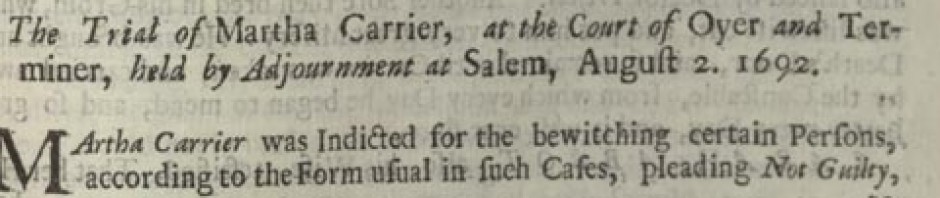
Petikan berita di surat kabar lawas tentang Martha Carrier yang diadili sebagai penyihir
(sumber: marthacarrier.org)


Mengapa pengadilan penyihir Salem harus terjadi?

Pertanyaan yang terus bercokol di benakku. Apakah –sebenarnya—ada praktik sihir dan penenungan di Salem? Setelah browsing di internet, aku tak menemukan informasi apapun tentang penyihir. Jadi, kesimpulanku, hal itu terjadi karena kombinasi sempitnya wawasan dan sifat buruk manusia. Peristiwa Salem dipicu oleh sakitnya anak perempuan Pendeta Parris. Di kemudian hari, gejala-gejala yang dideritanya disinyalir sebagai penyakit yang disebabkan karena semacam fungus yang menginfeksi bahan makanan yang dimakannya. Namun oleh penduduk gejala itu dikaitkan dengan buku Cotton Mather tentang praktek sihir, dan dengan kentalnya takhayul di antara mereka, maka mereka segera mempercayai bahwa si gadis kecil kena sihir (sumber: law2.umkc.edu). Hal ini diperparah dengan sistem hukum yang buruk dan adanya konflik pribadi antar keluarga atau tetangga, dan dengan gampangnya orang menuding orang lain sebagai penyihir. Dari sebuah kebetulan, akhirnya menjadi kepastian, karena manusia cenderung mempercayai apa yang ingin ia percayai.

Apakah praktek itu hanya terjadi pada abad-abad lalu, khususnya pada tahun kelam 1692 itu? Tidak. Hingga saat inipun kita juga sering cenderung mempercayai sesuatu yang ingin kita percayai. Ketika seorang mantan narapidana dituduh melakukan kejahatan, kita akan langsung percaya, karena di benak kita sudah terpancang anggapan bahwa narapidana = kriminal. Padahal belum tentu ia melakukan kejahatan yang dituduhkan. Coba saja, ketika seorang selebriti idola orang banyak dituduh melakukan hal buruk, pasti banyak yang tak percaya. Karena kita semua ingin mempercayai bahwa idola kita adalah manusia sempurna.

Bagaimana pun, The Heretic’s Daughter sekali lagi membuka mata kita pada kelemahan manusia. Meski sekarang manusia modern sudah lebih berwawasan dan kritis, namun kelemahan manusia itu tetap ada. Mari kita menjadi lebih kritis lagi pada apapun yang kita dengar/lihat. Jangan terlalu gampang larut dalam arus masa sebelum kita memahami duduk perkaranya dengan jelas.

3 bintang untuk buku ini!

Judul: The Heretic's Daughter
Penulis: Kathleen Kent
Penerbit: Matahati
Terbit: Mei 2011
Tebal: 282 hlm

Wednesday, February 23, 2011

Misteri Kematian Poe


Edgar Allan Poe, bagi yang (mungkin) belum mengenalnya, adalah seorang sastrawan besar Amerika. Beliau meninggal di Baltimore pada tahun 1849, dan sebab kematiannya hingga saat ini masihlah merupakan misteri. Dari sekian banyak sumber, dapat diambil kesimpulan bahwa Poe meninggal di Rumah Sakit Baltimore, empat hari setelah ditemukan dalam keadaan mabuk dan mengenaskan di hotel/kedai minum Ryan tepat pada hari diadakan sebuah pemungutan suara. Setelah itu segera diadakan sebuah pemakaman sangat sederhana, bahkan tanpa sebuah nisanpun, dan hanya dihadiri 4 orang kerabat dan teman lama Poe. Pemakaman itu begitu dingin, hambar, dan berkesan seadanya saja. Dan justru kesan itulah yang melekat di sanubari Quentin Clark, seorang pengacara tampan dan cerdas yang tepat saat pemakaman itu sedang melintas di depan makam.

Quentin adalah salah seorang dari sedikit saja pengagum karya-karya Poe pada saat itu. Pemikiran Poe yang tajam dan kritis, yang mengungkapkan kejeniusannya, tampaknya tak disukai oleh kebanyakan orang, termasuk media cetak yang pada masa itu sangat besar pengaruhnya dalam mempengaruhi opini massa. Media-media itu berlomba-lomba mencela Poe, menyebutnya memiliki moral dan mental yang buruk serta suka bermabuk-mabukan. Quentin sendiri telah beberapa saat berkorespondensi dengan sastrawan pujaannya ini, dan mengetahui bahwa Poe sedang berencana menerbitkan semacam jurnal sastra bertajuk The Stylus, yang akan menampilkan karya-karya sastra 'tingkat tinggi'. Hal itu memancing kebencian para pengarang ‘biasa’ karena membuat karya mereka jadi tampak picisan. Dari surat-menyurat itu, Quentin juga menyadari kegalauan hati Poe karena penolakan dunia terhadapnya, ditambah kondisi keuangannya yang buruk sehingga ia harus mencari dana kesana kemari demi terbitnya The Stylus.

Dari hubungannya dengan Poe, Quentin yakin bahwa Poe tidaklah sejelek yang dibicarakan orang saat itu, dan ini membuatnya termotivasi untuk membersihkan nama baik Poe sebagai sastrawan besar dunia. Hasrat Quentin untuk bertindak sebagai pengacara Poe yang sudah mati ini begitu besar hingga terpaksa mengorbankan kedudukannya di biro hukum yang diwarisi dari ayahnya dan dijalankan bersama Peter, saudara tirinya, juga hubungannya dengan seorang gadis yang dicintainya, Hattie Blum.

Lalu datanglah sebuah artikel yang menyebutkan bahwa karakter detektif dalam tiga kisah detektif yang ditulis Poe diambil dari sosok nyata seseorang yang tinggal di Paris. Nama detektif itu adalah C. Auguste Dupin, seorang jenius dengan kemampuan rasiosinasi (penalaran dengan menggunakan logika dan imajinasi tinggi). Maka Quentin pun pergi ke Paris untuk mencari dan menyeleksi sosok model itu, dan akhirnya menjatuhkan pilihan pada seorang Auguste Duponte.

Auguste Duponte, dengan kemampuan penalarannya yang hebat, telah sering membantu kepolisian Prancis menemukan kebenaran dalam kasus-kasus yang tak terpecahkan. Hal ini membuatnya mendapat banyak musuh yang membencinya, orang-orang yang tak ingin perbuatannya diketahui. Quentin menemukan Duponte dalam keadaan depresi karena hal itu. Dan setelah beberapa bulan merayu Duponte, akhirnya Quentin berhasil membawanya ke Baltimore untuk tinggal bersamanya di rumahnya, Glen Eliza, dan bersama mencari kebenaran dalam misteri kematian Poe.

Di sisi lain, datanglah seorang pengacara bernama Claude Dupin, atau biasa dipanggil Baron Dupin, yang muncul di Baltimore dan mengklaim dirinya sebagai sosok Dupin yang asli. Maka terjadilah sebuah kompetisi antara Duponte bersama Quentin, melawan si Baron bersama Bonjour, seorang wanita pencuri yang jadi asistennya. Banyak hal mencengangkan terjadi selama penyelidikan itu, dan bahaya pun beberapa kali mengancam jiwa Quentin. Sementara itu, pertunangan Quentin dengan Hattie terancam batal karena bibi Hattie dan nenek Quentin marah besar karena menganggap Quentin menodai nama besar keluarga dengan mangkir dari biro hukumnya dan malah mengurusi penyair dengan reputasi jelek yang sudah meninggal. Namun Quentin, dengan semangat berkobar untuk memulihkan nama baik Poe dan keberaniannya tetap melanjutkan penyelidikan bersama Duponte.

Di tengah penyelidikan yang berjalan bak siput, karena banyak orang dekat Poe sendiri tidak mau bersikap terbuka, Quentin mulai terombang-ambing kepercayaannya terhadap August Duponte. Ia bahkan sempat yakin bahwa mungkin Baron Dupin adalah sosok asli darimana karakter Dupin diambil. Baron Dupin sendiri adalah sosok yang menarik. Ia adalah pengacara yang kharismatik, mampu menyihir audience dengan caranya memaparkan kebenaran saat sidang. Namun ia juga tengah dililit utang sehingga akhirnya ikut menyelidiki kasus kematian Poe dengan harapan untuk mendapatkan uang. Ia malah ‘menjual’ acara di mana ia akan membuka kebenaran seputar rahasia kematian Poe.

Dan ceritapun makin bergulir dengan makin cepat dan makin menegangkan. Siapakah sosok detektif yang menjadi role-model Dupin dalam novel Poe? Auguste Duponte yang introvert dan tak banyak omong? Atau Baron Dupin yang flamboyan dan senang dihormati? Berhasilkah Quentin mengembalikan nama baik Poe? Oh….agaknya anda harus mengikuti langkah demi langkah, aksi demi aksi hingga ke halaman terakhir untuk dapatkan semua jawabannya. Di akhir novel ini, salah satu “Dupin” akan membeberkan analisisnya tentang apa yang dilakukan Poe saat ia bepergian dan akhirnya tiba di Baltimore, hingga saat kematiannya. Namun yang jelas, misteri sesungguhnya kematian Edgar Allan Poe masih tetap akan terselimut kabut tebal. Semua orang bisa menduga-duga, berspekulasi, menyusun kronologis, namun kebenaran yang sejati hanya Tuhan dan almarhum Edgar Allan Poe sendiri yang tahu….

Novel ini layak dibaca karena beberapa alasan…

Pertama, dengan membaca novel ini kita akan mendapat wawasan seputar kehidupan pribadi Poe di luar karya sastranya. Kisah cintanya, keluarganya, cita-cita dan idealismenya, juga kelainan kesehatan yang diidapnya. Kita juga akan melihat sikap terpuji Poe yang menolak perbudakan dengan rela menyisihkan sejumlah besar uang demi memberikan kemerdekaan pada seorang budak berkulit hitamnya: Edwin, padahal saat itu kondisi keuangannya sedang sulit. Hal-hal yang manusiawi inilah yang mungkin tak kita dapatkan dengan hanya mencari di Google…

Kedua, kita akan disuguhi banyak petikan dari ranah sastra karya Poe, puisi maupun kisah detektifnya. Bahkan karakter kisah detektifnya juga dipakai untuk menganalisis cara berpikir dan bertindak Poe sehubungan dengan penyelidikan kematiannya. Membaca The Poe Shadow--judul asli buku ini-- seolah mengapresiasi Edgar Allan Poe secara keseluruhan, ya tulisannya, ya pribadinya.

Ketiga, adanya unsur historis bercampur dengan fiksi menambah kenikmatan membaca buku ini. Matthew Pearl telah membingkainya dengan apik sehingga fakta dan fiksi itu mengabur tanpa batas, dan memberi kita sebuah nuansa kisah yang baru. Pearl sendiri mengklaim bukunya ini sebagai analisa misteri kematian Poe yang paling mendekati otentik, karena selain dari data-data yang telah ada hingga kini, ia juga memasukkan data-data baru yang belum pernah terungkap sebelumnya (lihat/dengar di videonya di: sini). Dan jangan khawatir, di catatan pengarang, Pearl akan memilah-milah mana fakta dan mana fiksi dari kisah ini, juga data-data baru yang ia dapatkan. Pendeknya, membaca kisah ini puas deh!

Catatan untuk penerbit Q-Press >> Sayang sekali buku seindah ini tidak diterjemahkan dengan lebih serius. Masih banyak salah ejaan yang tertebar di sana-sini. Cukup mengganggu meski akhirnya menjadi biasa karena ceritanya sendiri mampu mencengkeram gairah bacaku. Semoga Q-Press dapat lebih baik lagi di masa mendatang, karena saat ini terus terang aku jadi ragu untuk membeli buku terjemahan lainnya kalau tidak amat terpaksa. Dalam hal Misteri Kematian Poe, belum ada penerbit lain yang mau melirik buku ini untuk diterjemahkan….

Judul: Misteri Kematian Poe
Judul asli: The Poe Shadow
Penulis: Matthew Pearl
Penerbit: Q-Press
Cetakan: Juli 2007
Tebal: 796 hlm